Jul 29, 2026
OEM vs. Private Label Baby Products: What Buyers Should Know
Compare OEM and private label baby products, including customization, development time, MOQ, packaging, sampling, and the information buyers need before requesting a quote.
OEM vs. Private Label Baby Products: What Buyers Should Know
Brands and wholesale buyers often use the terms “OEM” and “private label” when discussing custom baby products. Although the two approaches can overlap, they may involve different levels of product development, customization, cost, and production time.
Understanding these differences helps buyers prepare clearer requirements, choose a suitable development route, and receive more accurate quotations.
What Are Private Label Baby Products?
Private label usually starts with an existing product design or established product structure. The buyer sells the product under their own brand and selects from the customization options supported by the supplier.
Depending on the product, private label customization may include:
- Brand labels and care labels
- Logo placement
- Existing colors or prints
- Individual packaging
- Instruction cards
- Carton markings
- Product sets or combinations
Because the basic product construction already exists, private label projects may require less development than fully customized OEM projects.
Private label can be suitable for:
- New baby care brands
- Retailers testing a product category
- Buyers seeking a faster route to market
- Smaller initial product collections
- Companies that do not require a unique construction
However, available options still depend on the product, materials, quantity, and production method.
What Are OEM Baby Products?
OEM projects generally involve a higher level of customization. A buyer may provide specifications, reference samples, drawings, dimensions, materials, or functional requirements for the supplier to develop.
An OEM baby product project may include:
- Custom dimensions and product structure
- Specific material requirements
- Custom foam density or thickness
- New prints and color matching
- Integrated or removable components
- Custom fasteners, straps, or zippers
- Branded labels and packaging
- Special carton or compression-packing requirements
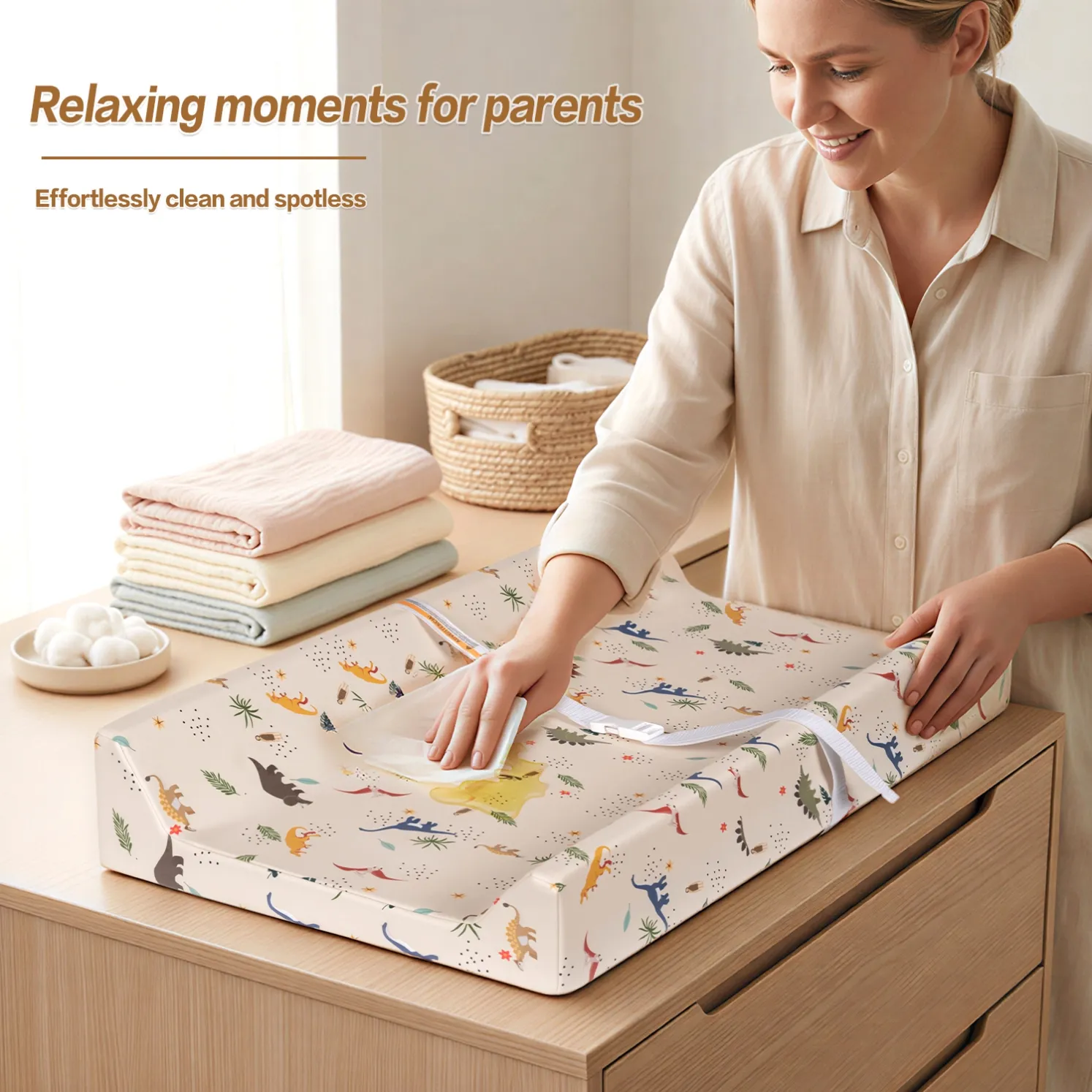
For example, an OEM changing pad project may specify a high-density foam core, a particular thickness, a soft waterproof PU cover, an integrated or removable zippered construction, and compressed packaging.
OEM development usually requires more detailed communication and sample evaluation because changes can affect materials, construction, tooling, packaging, and production.
The Difference Is the Level of Customization
The distinction between OEM and private label is not always identical across suppliers. Buyers should therefore focus on the actual scope of work rather than relying only on the terminology.
A private label project commonly uses an existing product with branding and packaging changes. An OEM project commonly involves changes to the product itself.
Before requesting a quotation, clarify whether you need:
- An existing product with your logo
- Existing construction in a custom color or print
- Adjusted dimensions or materials
- A new product structure
- Development based on a reference sample
- Custom retail or wholesale packaging
This information helps the supplier determine whether the request is private label, modified private label, or OEM development.
Compare Development Time
Private label projects may move more quickly when the product, material, and construction are already available. Development may focus on labels, artwork, packaging, and sample approval.
OEM projects usually require additional steps, such as:
- Reviewing the product brief
- Confirming materials and construction
- Preparing an initial quotation
- Developing a sample
- Reviewing and revising the sample
- Approving specifications and packaging
- Confirming bulk production
The timeline depends on the complexity of the product, material availability, sample revisions, order quantity, and packaging requirements.
Buyers should communicate their required delivery date early, especially when products are intended for a seasonal launch.
Understand MOQ and Cost Factors
Minimum order quantity is influenced by more than the finished product.
MOQ may depend on:
- Material minimums
- Custom color or printing requirements
- Label production
- Packaging quantities
- Product construction
- Production setup
- Carton configuration
A standard private label product may support a more flexible starting quantity than a fully customized OEM design. Custom materials, new prints, or unique packaging can increase minimum requirements.
To receive a useful quotation, provide an estimated quantity rather than asking only for the lowest possible MOQ. Suppliers can then recommend options that fit the intended order volume.
Plan Sampling Carefully
Samples help buyers evaluate the product before bulk production.
For private label projects, the sample may be used to confirm:
- Product quality and appearance
- Logo and label placement
- Color or print selection
- Packaging presentation
For OEM projects, sample review may also include:
- Dimensions and tolerances
- Material performance
- Foam firmness and thickness
- Construction details
- Zippers, seams, or fasteners
- Cleaning method
- Packing and shape recovery
- Requested functional changes
Feedback should be specific and recorded clearly. After revisions, the approved sample and written specification should be used as references for bulk production.
Confirm Packaging and Shipping Requirements
Packaging affects presentation, protection, carton volume, and shipping cost.
Buyers should specify whether they need:
- Polybag or individual retail packaging
- Printed boxes or simple export packaging
- Barcode labels
- Instruction cards
- Warning or care labels
- Custom carton markings
- Compressed packaging
- Product sets
For high-density foam changing pads, compression packaging can reduce packed volume and allow more units to fit into cartons or containers. This can help reduce freight costs, although the final saving depends on product dimensions, carton configuration, order quantity, shipping method, and destination.
Packaging should be discussed during product development rather than after the product has been approved.
Consider Testing and Destination-Market Requirements
Baby care products may be subject to different labeling, material, testing, and documentation requirements depending on the destination market and sales channel.
Buyers should identify applicable requirements before bulk production and communicate them in the initial inquiry.
Ask whether available test reports or material documents apply to:
- The exact product
- The selected material
- The selected color or component
- The intended destination market
Avoid relying on general statements such as “baby safe” without confirming the test scope and supporting documentation.
What Information Should Buyers Provide?
A complete inquiry helps the supplier recommend suitable options and prepare a more accurate quotation.
Include:
- Product name or reference images
- Target dimensions
- Preferred materials
- Required functions
- Estimated quantity
- Logo and label requirements
- Packaging requirements
- Destination country
- Required testing or documentation
- Target delivery date
- Whether a sample is required
If some details are undecided, explain the intended use and target price position. The supplier can then propose available constructions or materials.
Which Option Is Right for Your Brand?
Private label may be appropriate when you want an established product with customized branding and packaging. OEM may be better when product dimensions, materials, construction, performance, or packaging need to be developed around your requirements.
The right option depends on:
- Required differentiation
- Development budget
- Target quantity
- Launch timeline
- Product complexity
- Destination-market requirements
Starting with a clear product brief makes either route more efficient.
Start Your Baby Care Product Project
Dropshipins Baby supports wholesale, OEM, and private label projects for changing pads, baby bibs, shopping cart covers, and high chair accessories.
We can discuss materials, sizes, colors, prints, labels, packaging, samples, and order requirements based on your target market.